On this page
Rust async channels with tokio
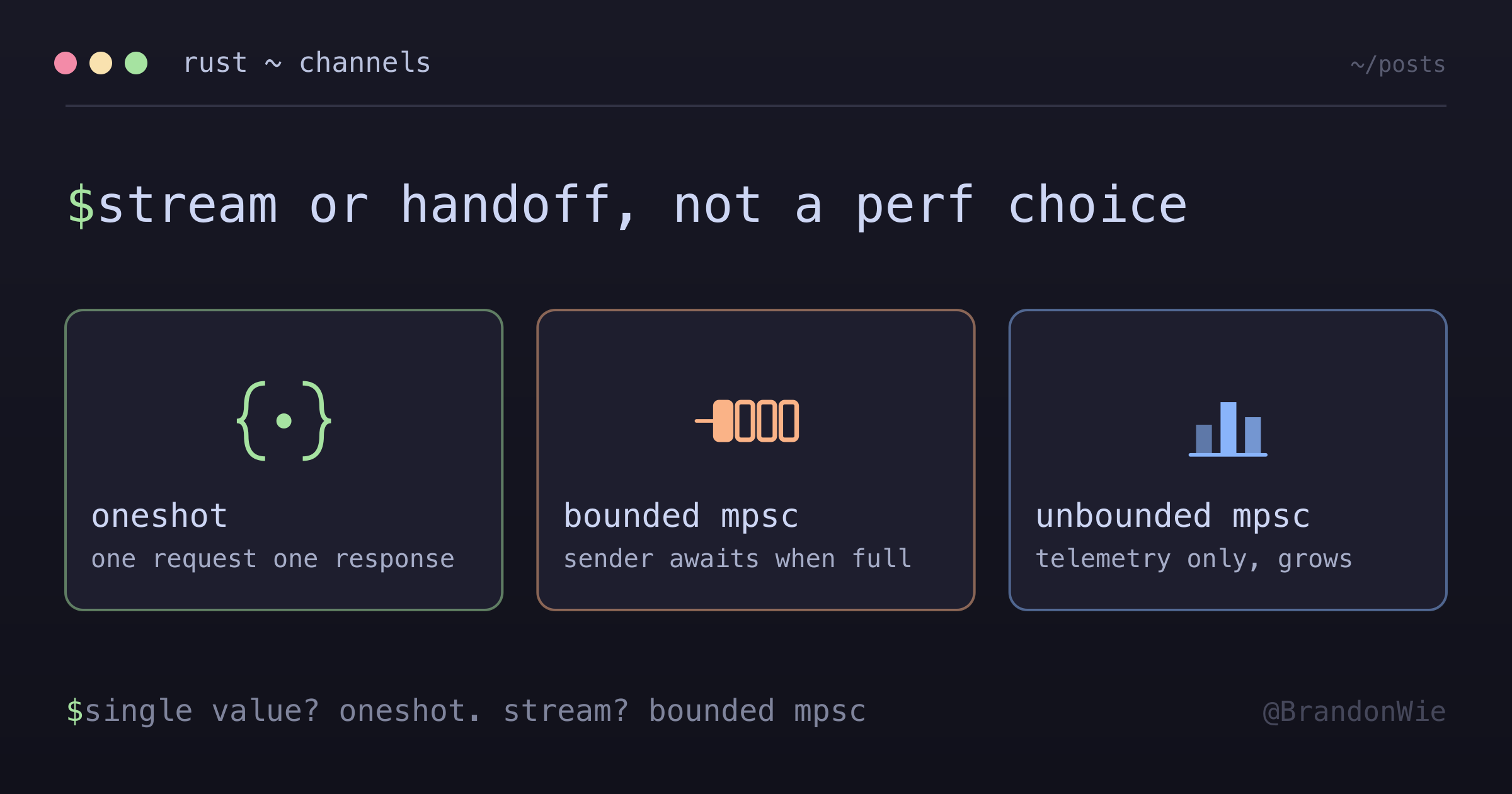
Choosing between tokio's mpsc, unbounded mpsc, and oneshot channels is a stream-vs-handoff decision, not a performance one.
Coordinating work between async tasks in Rust means passing typed messages between them. The standard library gives you std::sync::mpsc, but it is synchronous and blocking — there is no async equivalent. Tokio’s tokio::sync module fills that gap, and it offers three channel types that look interchangeable at first glance: bounded mpsc, unbounded mpsc, and oneshot.
The recurring question is which one to reach for. I found that picking the wrong one does not fail loudly — it surfaces later as unbounded memory growth, missing backpressure, or a pile of boilerplate. The whole decision comes down to one question: is this a stream of messages, or a single handoff?
Why the choice is easy to get wrong
Each variant encodes a different contract, and the failure modes only show up under load or during shutdown — not in the happy-path test you write first. That is what makes the choice deceptive: every option compiles and works in a quick demo, so the cost of the wrong one is deferred rather than avoided.
What follows is the decision rule I settled on, along with the dead ends and misleading signals that pushed me toward it. The code is Tokio, but the stream-vs-handoff framing carries over to channel selection in most async runtimes.
The dead ends that shaped the rule
A few things tripped me up before the rule clicked.
The first was using a second mpsc::channel(1) for request/response pairs. It works — send the request, the worker sends one value back, done. But it bloats every call site: each caller spawns a fresh channel only to push a single value through it. That is exactly the job oneshot exists for.
The second was trusting the name unbounded_channel. It reads as “no backpressure problems to worry about,” which holds right up until producers outpace consumers — then the queue grows without limit and you have a memory leak. The “unbounded” label hides the failure mode rather than removing it.
A smaller gotcha: tokio::select! over multiple receivers needs &mut rx in each branch. Move the receiver into the macro and the next loop iteration fails to compile with “use of moved value.”
And the one that cost the most time: treating SendError as a bug. When tx.send(...) returns SendError after the receiver was dropped, that is usually a clean shutdown signal — the consumer went away on purpose — not something to debug.
The decision rule
The question that resolves it is whether a stream of values flows or a single value flows back:
| Channel | Use for | Backpressure |
|---|---|---|
oneshot::channel | One request → one response | N/A — a single value flows |
mpsc::channel(N) | A stream or queue of messages | Yes — the sender awaits when full |
mpsc::unbounded_channel | Fire-and-forget telemetry only | None — can grow without limit |
In practice that means:
- One-to-one handoff (a request and its single response):
oneshot::channel. The send is non-blocking, and the channel drops itself once the value is delivered. - A stream or queue (many messages over time):
mpsc::channel(N), withNsized for the backpressure you want. It is bounded by default, so the sender awaits when the buffer is full — that waiting is the feature, not a limitation. - Fire-and-forget telemetry, and only that:
mpsc::unbounded_channel. If you use it, leave a comment explaining why, so the next reader does not “fix” it back to bounded for safety and reintroduce blocking where you wanted none.
Here is each pattern in code:
use tokio::sync::{mpsc, oneshot};

// Request / response — 1-to-1
async fn fetch(req: Request) -> Response {
    let (tx, rx) = oneshot::channel();
    spawn_worker(req, tx);
    rx.await.expect("worker dropped before sending")
}

// Stream of work — many-to-1
async fn run_pipeline() {
    let (tx, mut rx) = mpsc::channel::<Event>(64);
    for _ in 0..4 {
        let tx = tx.clone();
        tokio::spawn(produce_events(tx));
    }
    drop(tx); // Last clone — receiver loop exits when all producers done
    while let Some(event) = rx.recv().await {
        handle(event).await;
    }
}

// Select over multiple receivers — &mut required
async fn merge(mut rx_a: mpsc::Receiver<A>, mut rx_b: mpsc::Receiver<B>) {
    loop {
        tokio::select! {
            Some(a) = rx_a.recv() => handle_a(a).await,
            Some(b) = rx_b.recv() => handle_b(b).await,
            else => break,
        }
    }
}
Two details in that last block are worth pausing on. tokio::select! borrows &mut rx_a and &mut rx_b rather than taking the receivers by value — otherwise the loop only compiles for its first iteration. And the else => break arm is what gives you a clean exit: once every sender has dropped, both recv() calls return None, the branch guards fail, and the loop ends on its own.
The drop(tx) in run_pipeline is the same idea from the sending side. After cloning a sender for each producer, the original handle has to be dropped, or the receiver loop waits forever for a sender that never sends. And SendError after the receiver drops is, again, the shutdown signal — match it explicitly instead of propagating it with ?, unless the caller genuinely treats a gone-away consumer as a failure.
Why bounded is the default that matters
The thread tying all of this together is backpressure. A bounded mpsc makes the sender wait when the consumer falls behind, which keeps memory flat and turns overload into latency you can measure rather than a leak you discover in production. oneshot sidesteps the question entirely because exactly one value ever flows. Unbounded channels remove the backpressure signal, which is why they belong only where the volume is naturally self-limiting — telemetry you would rather drop than block on.
If you need the exact guarantees of each type, the Tokio tutorial’s channels chapter and the tokio::sync module docs are the canonical reference.
When to reach for these — and when not to
Reach for tokio::sync channels when:
- You are coordinating async tasks that exchange typed messages.
- You want bounded backpressure between a producer and a consumer.
- You need a request/response handoff where exactly one value flows back.
- You have a multi-producer pipeline that should shut down cleanly once every producer finishes.
Reach for something else when:
- The code is synchronous — use
std::sync::mpscorcrossbeam. - You need pub/sub fanout to multiple consumers —
mpscis single-consumer, so usetokio::sync::broadcast. - You only care about the latest value — use
tokio::sync::watch, which keeps one value instead of buffering all of them. - You are crossing process boundaries — these are in-process primitives; reach for a real message bus like NATS or Redis.
The one-sentence version: if a single value flows back, use oneshot; if a stream flows, use a bounded mpsc and let backpressure do its job.