On this page
Codex `apply_patch` Hooks: The Matcher Fires, the Payload Differs
Corrected 2026-09-20. Codex hooks do see `apply_patch` as a tool, and an `Edit|Write` matcher reaches it. What still breaks a reused Claude hook is the payload: patch text instead of a file path, and many files per call.
Correction, 2026-09-20. This post first shipped in May 2026 under the title “Codex
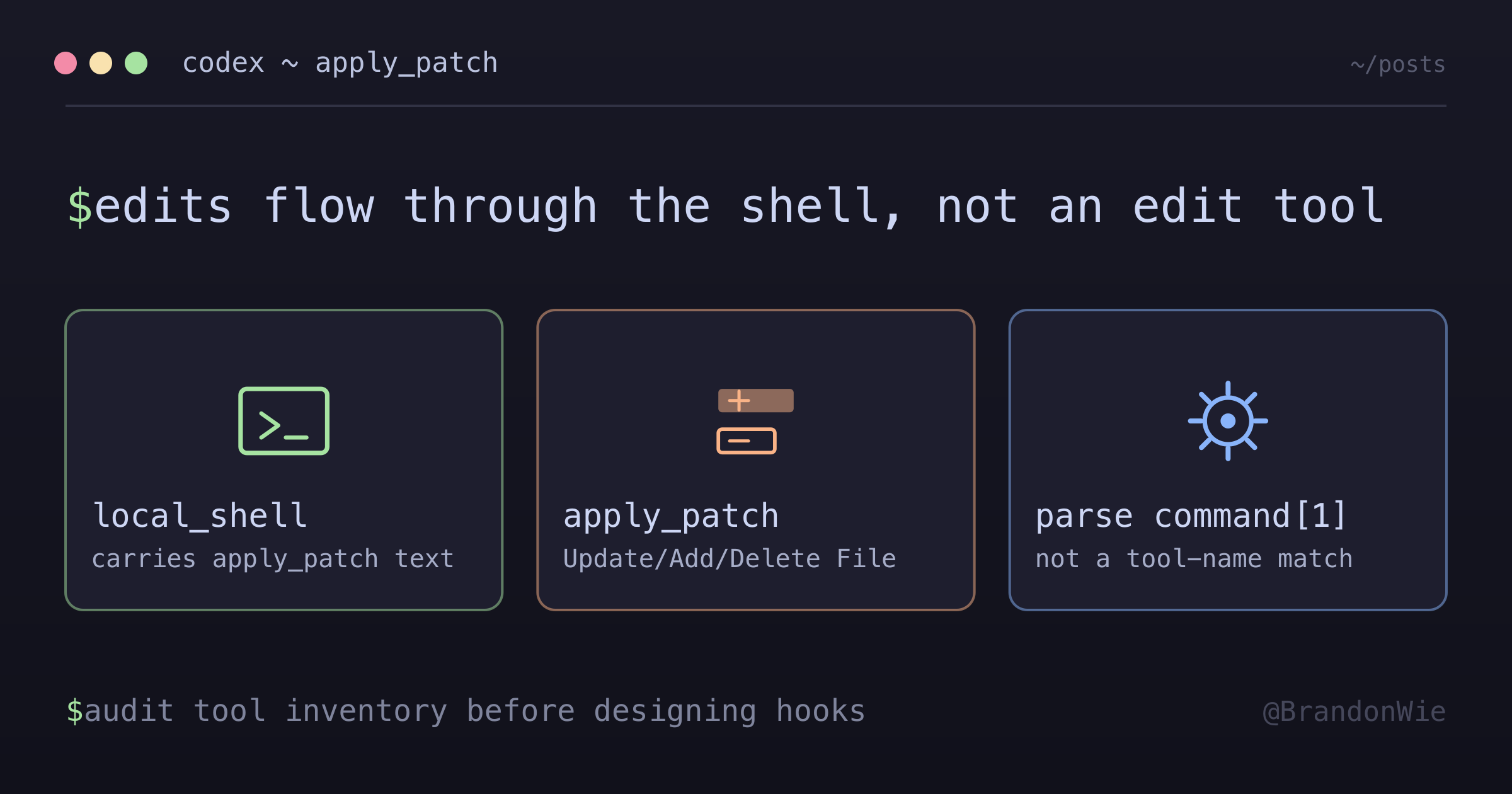
apply_patchis a Shell-Mediated Tool, Not a Direct Tool”. Its central claim was wrong for current Codex: I said a hook matcher namingapply_patchcould never fire. It does fire. The sections below are rewritten against the current hooks documentation and a re-test on Codex 0.154.0. The original reasoning is kept at the end, labeled as history, because how I got it wrong is the useful part.
I wanted one PostToolUse hook to refresh a code graph after every file edit,
on both Claude Code and Codex. The Claude version already existed, with the
matcher Edit|Write|MultiEdit|NotebookEdit and a script that read tool_input.file_path. The plan was to copy it into the Codex profile
unchanged.
In May I concluded that the copy would never fire on Codex. That was wrong. The copy fires. It then reads a field that is not there and does nothing, which is a quieter failure than the one I described, and a harder one to notice.
What Codex hooks see today
The Codex hooks documentation lists apply_patch in its tool coverage table with both PreToolUse and PostToolUse supported. A matcher can name it three ways: apply_patch, Edit, or Write. Whichever alias matched, the hook input still reports the
tool name as apply_patch.
Shell execution is a separate row. Shell commands and unified exec
(exec_command) both match as Bash.
The same page says apply_patch carries its input in tool_input.command. I
re-tested on Codex 0.154.0 in an isolated profile: a PreToolUse hook with
the matcher apply_patch fired on a native edit, denied it, and then accepted
the retry. The payload has this shape:
{
  "tool_name": "apply_patch",
  "tool_input": {
    "command": "*** Begin Patch
*** Update File: src/app.ts
@@ ...
*** End Patch"
  }
}
So the matcher half of my reuse plan was fine. Edit|Write reaches Codex file
edits through the documented aliases.
Where the reused hook still breaks
The script is the problem. A Claude edit hook reads one path from tool_input.file_path. On Codex that field does not exist. My hook guards an
empty path with exit 0, so it runs, finds nothing, and exits clean. Nothing
in the logs says it skipped.
Two differences drive the rewrite:
- The paths live inside the patch text, declared by three directives:
*** Update File: <path>,*** Add File: <path>, and*** Delete File: <path>. - One call can touch many files. A single patch may carry several directives, so the hook has to loop.
A minimal extractor for the Codex side:
#!/usr/bin/env bash
# Reads hook JSON on stdin, prints one affected path per line.
jq -r '.tool_input.command // empty'
  | grep -E '^*** (Update|Add|Delete) File: '
  | sed -E 's/^*** (Update|Add|Delete) File: //'
Everything after that point, such as a privacy filter or a debounce, can be shared between agents. Only the path extraction differs.
Side by side
| Concern | Claude Code | Codex CLI |
|---|---|---|
| Tool name to match | Edit\|Write\|MultiEdit\|NotebookEdit | apply_patch (aliases Edit, Write) |
| Reported tool name | the matched tool | always apply_patch |
| File path source | tool_input.file_path | parse directives in tool_input.command |
| Files per call | 1 | 1 to many |
| Script reuse | direct | shared policy, agent-specific path reader |
One boundary I have not tested: file writes made through a shell command
rather than through apply_patch. The documentation routes those through the Bash row, so an edit hook keyed on apply_patch will not see them. Treat
each surface as separate until you have watched its payload yourself.
How I got it wrong
This section preserves the May 2026 reasoning. Its conclusion is superseded.
I inspected the Codex binary with strings and found apply_patch only
inside the instructions template, as an example the model is told to follow:
- Use the `apply_patch` tool to edit files
  (NEVER try `applypatch` or `apply-patch`, only `apply_patch`):
  {"command":["apply_patch","*** Begin Patch\n*** Update File: ..."]}
From that I inferred three things: that apply_patch was the first argument
to a shell tool, that it was never a registered tool name, and that a matcher
naming it would match nothing. I recommended matching the shell tool family
and parsing command[1].
The excerpt shows a shell invocation form. It cannot show which tools the running client registers, or what payload a hook receives. I read a static artifact and reported runtime behavior. A five-minute hook that logged its own input would have answered the real question, in either direction.
Key points
apply_patchis hook-visible.PreToolUseandPostToolUseboth support it, andEditorWritework as matcher aliases.- A reused Claude hook fails after it fires. It looks for
tool_input.file_path, finds nothing, and exits without an error. - The paths only exist in the patch text. Extract them from the
Update File,Add File, andDelete Filedirectives. - Loop over the paths, because one patch can touch several files.
- Binary strings are not runtime evidence. Log a real hook payload before you design against it, and log it again after a version bump.
When to use this
- Porting a Claude Code edit hook to Codex, or the reverse.
- Debugging a Codex hook that matches but has no effect.
- Auditing a cross-agent hook design before committing to script reuse.
When not to use this
- Single-agent hook design, where the payload difference never comes up.
- Server-side tool design. This is about the CLI hook lifecycle only.
Takeaway
“Edit tool” is not a uniform concept across agents. Claude Code passes a file path. Codex passes a patch. The matcher can look identical on both and the script underneath still has to be written for the payload it will receive.
So I do it in the other order now. Log one real event, read what it actually contains, and write the hook against that.
See also
knowledge/ai-ml/cross-agent-skill-alias-generalization.md: the companion cross-agent compatibility pattern at the skill-alias layer.projects/3b/decisions/019-graph-tool-integration.md§ Update: documents the Phase 0a deferral with this rationale.tmp/archived-tasks/40-wrap-graph-freshness-gate/round-1-review.md(and the originalproactive-review.md): full session context.